Saturday, February 6, 2016

Lesson 10: THE COMPUTER AS TUTOR


The computer can be a tutor in effect relieving the teacher of many activities in his/her personal role as classroom tutor. It should be made, however that the computer cannot totally replace the teacher since the teacher shall continue to play the major roles of information deliverer and learning environment controller. Even with the available computer and CAI software, the teacher must insure that students have the needed knowledge and skills for any computer activity. The teacher also decides the appropriate learning objectives, plan the sequential and structured activities to achieve the objectives and evaluate the students' achievement by way of tests.


Lesson 9: COMPUTER AS INFORMATION AND COMMUNICATION TECHNOLOGY


Instructional media consist of audio-visual aids that served to enhance and enrich the teaching- learning process. Examples are the blackboard, photo, film and video. On the other hand, educational communication media comprise the media of communication to audiences including learners using the print, film, radio and television or satellite means of communication. For example, distance learning were implemented using correspondence, radio, television or the computer satellite system. 


Lesson 8: HIGHER THINKING SKILLS THROUGH IT-BASED PROJECTS


There are four types of IT-based projects which can effectively be used in order to engage students in activities of a higher plane of thinking. (1)The Resource-based Projects, the teacher steps out of the traditional role of being an content expert and information provider, and instead lets the student find their own facts and information. (2)Simple Creations, they can create their software materials to supplement the need for relevant and effective materials. (3)Guided Hypermedia Projects is production of self-made multimedia projects can be approached in two different ways: As an instructive tool, such as in the production by students of a PowerPoint presentation of a selected topic. As a communication tool, such as when students do a multimedia presentation like graphs, photos, interviews and video clips. (4) Web-Based Projects, students can be made to create and post web pages on a given topic. Creativity projects as tools in the teaching-learning process can be achieved with the assistance of advisers adept in the technical use of Internet Resources.


Lesson 7: IT FOR HIGHER THINKING SKILLS AND CREATIVITY


In the traditional information absorption model of teaching, the teacher organizes and presents information to student- learners. He may use a variety of teaching resources to support the lesson. The presentation is followed by discussion and the giving of assignment. Today, students are expected to be not only cognitive but also flexible, analytic and creative.


Lesson 6 - Developing Basic Digital Skills


Teachers in the modern times are rapidly improving particularly on their way of teaching to match the new digital world of information and communication technology (ICT). In developing a digital learner, it must be clear to them on what basic knowledge, skills and values which need to be developed. These basic literacy will not replace the 3 R’s (reading, writing, arithmetic) instead they will complemented by six essential skills namely: Solution fluency that focuses on to learners capacity and creativity in problem solving, Information fluency that involves the ability to access information, retrieve and reflect on the information, Collaboration fluency that talks about teamwork, Media fluency in communication, Creativity fluency in artistic proficiency and Digital ethics that states about the different principles of leadership, global responsibility and citizenship, environmental awareness and personal accountability.


Friday, January 8, 2016

Lesson 5 - Preferences of the Technology Generation


What the old generation likes may not be the same as what the new generation prefers in their life, work and leisure. Sad to say, much of the good things enjoyed by elders when they were students are no longer available to the new generation.
The state dictates educational priorities based on perceptions on the country’s need to strengthen its agricultural, business or industrial economy.
In the field of education, it is important that critical differences in perception between old and young which create a generation gap:

·         Texts versus Visual
·         Linear versus Hyper media
·         Independent versus Social learners
·         Learning to do versus learning to pass the test
·         Delayed rewards versus instant gratification
·         Rote memory versus fun learning

In sum, teachers need to connect with digital learners, and not think of them as entering their past-30 years old traditional world. While there are apparent setbacks or limitations to digital learning, there are opportunities to tap through:
·         visual learning
·         hyper linked multimedia
·         problem-solving activities

Reflection:
       Preferences of the Technology as an instructional media were indeed a very big help in the new generation learners but we must know as a teachers what the appropriate use of it. We must also know when and how to limit these technologies in order for us to prevent our learners to become abusive and addicted to it.


Tuesday, January 5, 2016

Lesson 4 - Bridging Generation Gap


The older generation often feels there is a generation gap between them and the younger generation. This is apparent in simple things like the manner of dressing, socializing, more intimate relationship like friendship and etc. Still, some old things are difficult to overcome, as there are still the caste system in India, pre-arranged marriage in China, female circumcision in Africa, and theocratic or religion-rule societies in the Middle East. Even in education, traditional schooling has hardly changed even with the clear evidence of a digital world. Reflect on how some teachers confine their teaching to the board talk-test method.

In the field of education, a huge generation gap also exists and it will continue to widen unless some changes are adopted at the proper time. In peasant third world countries where schools don't have technology facilities, it is understandable that the transition to digital education may take time. But given the rapid emergence of digital technology, at times referred to as information and communication technology (ICT), there is the need to prepare for bridging the digital gap in society.
First, we need to understand the potentials of ICT:
  •        The new network of instantaneous communication is global, overcoming borders between countries and continents.
  •         Much of what elders believe may not be applicable anymore to the new generation, especially along matters of traditional value system.


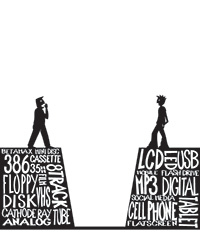
Given the speed and power of ICT for change, growth, innovation, it becomes critical that teachers understand the gap that may be perceived between them and the new generation of learners. Much of the old technology such as tube radio, platter records, cassette tapes, celluloid movies, antenna television, landline phones, have vanished or are quickly vanishing today. Even in communication, sending a written letter has become tedious with the advent of emailing and web-camera face-to-face communication. As sophisticated technology advances at a dizzying pace, the complacency of educators to stick to traditional education system and approaches become futile, if not retrogressive.  Since the new generations are expected to face a future professional challenge of a digital world ahead of them, technology-supported skills need to be taught in schools today, or else schools will become a white elephant. If schools fail to respond to emergent changes and needs, new learners may lose appreciation of the educational system, and drop out of schools, as surveys show an increasing drop-out rate every year. Learning at home and availing digital learning systems like the Open Universities may save the day, but the situation remains bleak for schools stolidly adhering to the old educational system.